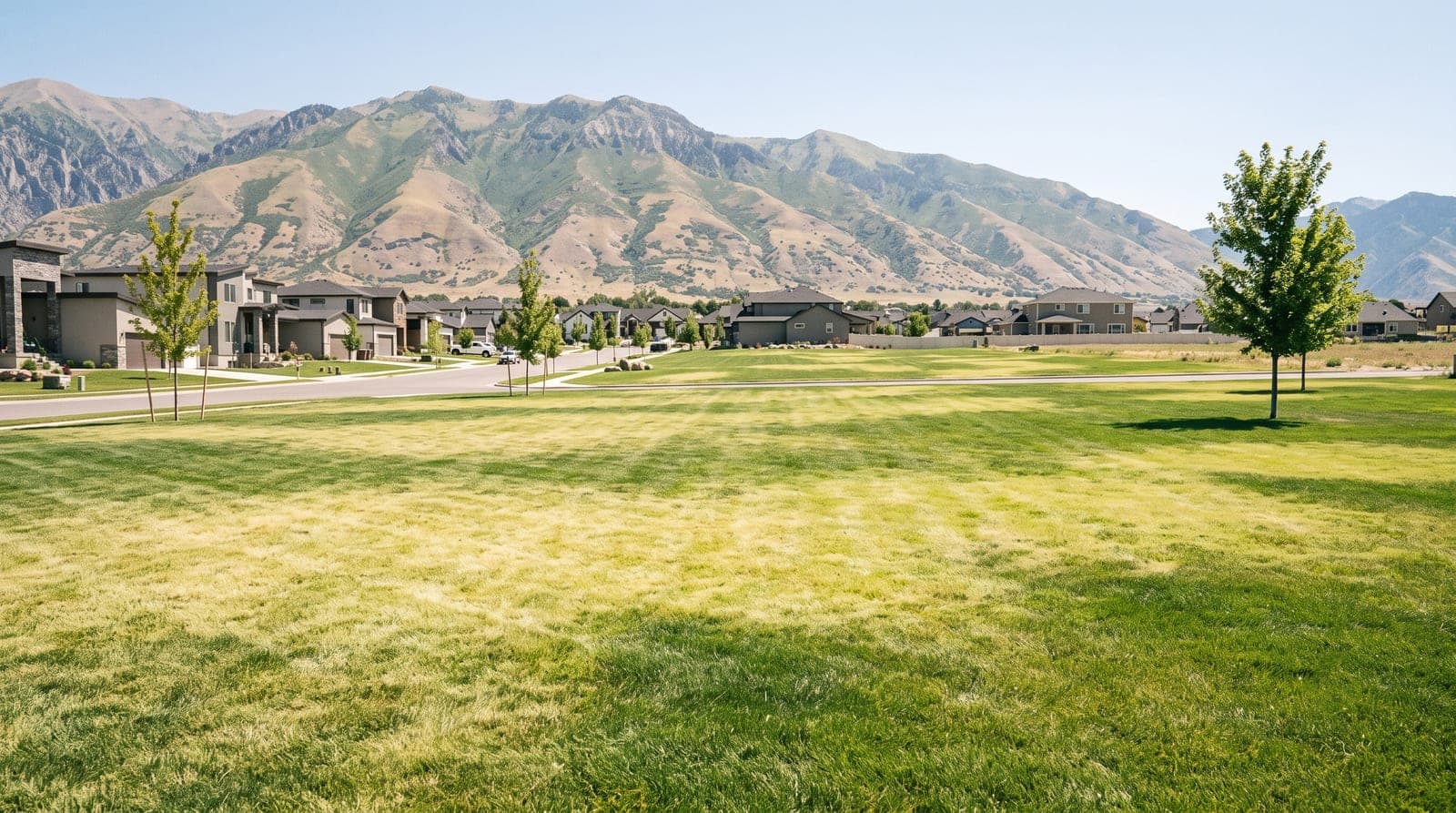
Every July, the calls start. The lawn was deep green in May, and now it's gone pale — a flat, yellow-green color, worst on the newest growth. The homeowner has done the reasonable thing and turned the water up. A week later it looks the same, or worse. By the time they call, they're convinced something is wrong with the irrigation.
In Cache Valley, it almost never is. The water is rarely the problem. The soil is.
Pale isn't the same as dry
A drought-stressed lawn and an iron-starved lawn look different once you know what you're looking at. Drought stress shows up as a blue-gray cast, footprints that stay pressed into the grass, and blades folding in on themselves. Iron deficiency shows up as a uniform yellow-green — the lawn is well-hydrated, even lush, just the wrong color, and the newest growth at the top is the palest.
That distinction matters, because the instinct — more water — does nothing for an iron problem. Worse, in the July heat, pouring on extra water often backfires: it drives shallow rooting, invites disease, and leaves the lawn less able to handle August. You can water a yellow lawn every day and it will stay yellow.
The real cause is underfoot
Cache Valley sits on limestone-derived, calcareous soil. Most lawns here test alkaline — commonly pH 7.5 to 8.2. That number is the whole story.
Iron is usually present in our soils in plenty. But at high pH it converts to forms the plant simply can't absorb. The iron is there; it's just locked up. The grass, unable to pull it from the soil, can't build chlorophyll, and chlorophyll is what makes it green. The result is the classic high-desert summer lawn: fed, watered, and pale.
This is called iron chlorosis, and it is the single most common thing I'm called out to fix between June and August.
Why "just fertilize it" makes it worse
The usual response — another round of weed-and-feed, heavy on nitrogen — is the wrong move twice over.
First, nitrogen isn't the deficiency. Pushing a cool-season lawn to grow hard in the heat of July stresses it; you get thin, soft growth that scorches and invites disease, not the deep green the owner is after.
Second, it treats a symptom while ignoring the cause. The lawn doesn't need more food dumped on top of soil it can't draw from. It needs the chemistry corrected so it can use what's already there.
How we actually fix it
The first step is the same one we take on every property: a soil test. It confirms the pH, shows where iron and the other micronutrients actually sit, and tells us whether we're looking at a true deficiency or something else. We don't guess at color problems — we measure them.
From there, the fix is targeted:
- Chelated iron, not just iron sulfate. Plain iron sulfate applied to high-pH soil tends to lock up almost as fast as the iron already in the ground. A chelated iron holds in an available form long enough for the lawn to use it, and a foliar application greens things up within days while the soil-side correction takes hold.
- A summer-safe feeding, not a heavy one. Through the heat we lean on a slow-release blend that holds color without forcing growth the lawn can't support — paired with the iron, that's what carries color through July and August.
- The long game on pH. You don't flip an alkaline soil overnight, and you don't need to. The goal is a steady, season-over-season nudge toward better availability, not a dramatic swing.
What you can do this week
Before we ever get there, a few things help on any pale Cache Valley lawn:
- Raise your mowing height. Longer blades shade the soil, hold moisture, and root deeper. In July, cut high.
- Water deep and infrequent, early. A few longer soakings beat daily light sprinkling — it sends roots down instead of keeping them at the surface. Run it before sunrise to cut evaporation and disease pressure.
- Hold off on the heavy nitrogen. If the lawn is pale, more nitrogen in the heat is the wrong lever. Wait for fall.
- Get a soil test. It's the only way to know whether you're chasing iron, pH, or something else entirely — and it's where every lawn we take on begins.
A pale July lawn isn't a watering failure, and it isn't a lost cause. It's a chemistry problem in soil that's been the same since long before the lawn went in. Once you read the soil instead of guessing at the symptom, the green comes back — and it stays.
If your lawn's gone pale and you'd rather know why than keep pouring water on it, request a free assessment and we'll start with the soil.